Watching a Rugby Match Without Chasing the Ball
Watching a rugby match without chasing the ball reveals how defenders reorganise, where space opens and why the next pass may find a different picture.
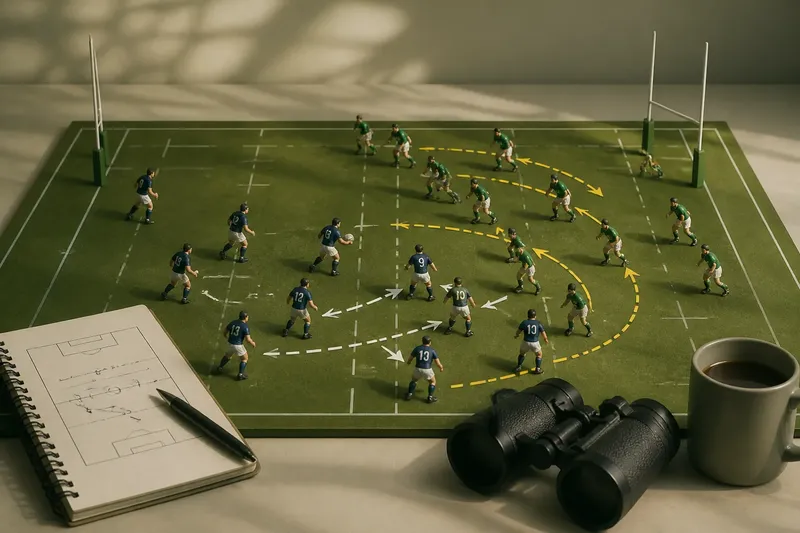
The common mistake when watching a rugby match is to chase the ball from pass to pass. That leaves little room to notice why one attack suddenly runs out of options. Try reading the passage as a sequence of decisions instead: where does the defence invite play, and what changes when the attack accepts or rejects that invitation?
This is not an exercise in naming every formation. It is a way to connect a visible choice with its immediate consequence. Keep the ball in sight often enough to know what the attack does, but give equal attention to the spaces the defenders leave and then try to close.
What does the defence appear to offer?
Choose open play shown from a wide camera angle. Start when the attacking side has time to spread across the pitch, rather than during a crowded collision or a close-up replay. Follow one attack for a few phases, noting the space that looks easiest to reach before the ball moves.
Look beyond the first defender. Is there room near the touchline? Is the middle crowded? Are defenders standing deep enough to give the attack time, or advancing to narrow that time? Treat these as observations, not proof of a planned trap. A broadcast view can hide players and make a gap appear larger than it is.
Then watch the next attacking choice: a pass wide, a carry into contact, or a return towards the middle. Ask whether that choice uses the apparent space or makes the defence turn and reorganise. The interesting detail is often not the pass itself, but what it forces the defenders to do next.
How can you follow the exchange of choices?
Read a phase as a simple exchange. The attack presents a threat; defenders adjust their spacing and direction; the attack either tests that adjustment or changes the point of attack. A defence sliding towards one side may make that side harder to reach, while leaving fewer defenders immediately available on the far side.
Notice the cost of each adjustment. When defenders move across, do they stay connected, or does a gap appear between two players? When they advance, does the attack have to pass sooner or retreat? After a tackle, does the defensive line recover quickly, or do some players remain close to the contact area while others cover the width?
These signs do not settle whether a team has made the right choice. They show the problem each side is trying to solve. A line can look organised and still be stretched by a quick change of direction; an apparent opening may disappear before the ball reaches it.
Say an invented attack begins with the ball near the middle, with defenders leaving visible room towards the right touchline. The attacking side moves the ball right; the defence slides across and the outside space narrows. The attack then passes back inside, where two defenders are turning to recover. The observable result is a brief inside channel, but whether it is usable depends on the next pass, the players’ positions and the speed of the reset.
How can you make a useful note?
A short note should record a cause and an effect, not a verdict. Try a line such as “defence slides right; inside space opens briefly” or “advance forces an early pass; attack goes back”. This is more useful than writing “good defence”, because it preserves what you actually saw.
If you are watching with a friend, compare what each of you noticed before discussing whether the attack could exploit it. One person might track the ball-carrier while the other watches the defensive spacing. Keep the disagreement specific: did the gap open before the pass, or only after the defenders had turned?
- Observation: the defence moves towards the ball. If the far side becomes visibly thin, then watch for a switch of play; otherwise, track whether the attack keeps the defence moving.
- Observation: two defenders lose their spacing. If a channel appears between them, then note whether the attack targets it; otherwise, check whether the line closes it before the next phase.
- Observation: the defence advances together. If the carrier has less time, then watch for an early pass or a retreat; otherwise, see whether the defenders maintain their line after the attack changes direction.
- Observation: several defenders gather near a tackle. If the outside is left with fewer visible defenders, then follow the next pass wide; otherwise, watch how the remaining players cover that edge.
- Observation: the attack turns back towards the middle. If defenders are still facing the touchline, then note whether an inside option appears; otherwise, see whether they reset in time to close it.
- Observation: the broadcast cuts to a tight shot. If the defensive shape is no longer visible, then stop drawing conclusions from the unseen space and resume with the next wide view; otherwise, compare the line before and after the pass.
What questions help you read the exchange?
Why might defenders leave one side open?
They may be moving towards the immediate threat or protecting a more dangerous route. A wide camera angle can also make the far side look emptier than it is.
Does an open channel mean the attack should use it?
Not necessarily. The ball may not arrive in time, or the defenders may close the space before a runner can reach it.
What does a defensive reset look like?
Players turn back towards the attack, spread out and reconnect their spacing after a carry or tackle. The line may remain uneven while some defenders recover from the previous phase.
What if the camera hides the far side?
Wait for a wide shot rather than guessing. Until then, follow only the visible movement and leave the unseen shape out of your note.
How do you turn one passage into a full read?
Imagine an invented viewing session: the starting picture is an attack near the middle, a defence leaning towards the left, and a wide broadcast angle. First, note that the right side appears less crowded. Next, watch the attack pass left; the defenders slide that way and the visible right-side space grows. Then the attack turns back inside, and the nearest defenders have to change direction. The resulting answer is not “the right side was definitely free”: it is that the defence’s shift created a moment when the middle needed a reset, while the camera and timing leave the exact opportunity uncertain.
After that passage, return to watching the match normally. On another attack, compare the order of events: did the defence move before the pass, or react after it? That small distinction helps you see whether space appeared because the attack changed the picture or simply because players were still recovering.
Watching a rugby match without chasing the ball is most useful when it sharpens your next question. Once you spot a defensive shift, look for the attack’s response and the line’s recovery; the answer often lies in what happens after the apparent gap, not in the gap alone.